

Several pairs of children’s moccasins are placed at the Permanent Peoples’ Tribunal, representing the Indigenous children who disappeared or never returned home from Indian Residential Schools.
In May 2026, the Permanent Peoples’ Tribunal (PPT) on Missing Children and Unmarked Burial convened in Montreal to hear Survivor testimony, review expert evidence, and apply international legal analysis to examine Canada’s treatment of Indigenous Peoples.
A central question before the Tribunal was whether the actions and policies of the Canadian state toward Indigenous Peoples, including those associated with the Indian Residential school system (IRS), meet the legal definitions of genocide and crimes against humanity under international law.
During the tribunal, the judges heard expert testimony from Professor Fannie Lafontaine, a Professor of International Law, a human rights lawyer, and genocide expert. Lafontaine provided important context on how genocide and crimes against humanity are defined under international law and how these legal frameworks can apply when examining long-term patterns of state policies and actions.

Professor Fannie Lafontaine provides expert testimony during the Permanent Peoples’ Tribunal on Missing Children and Unmarked Graves and Burial Sites in Montréal, May 2026.
Throughout her testimony, Lafontaine emphasized that understanding these crimes requires looking beyond individual events and examining the broader systems, policies, and practices that have affected Indigenous Peoples across generations.
Understanding Genocide Under International Law
During her testimony, Lafontaine explained how genocide is understood within the framework of international law. She encouraged the Tribunal to move beyond the “Holocaust paradigm”, the idea that genocide must look like the Holocaust or involve large-scale killings to meet the legal definition.
“The interpretation of genocide needs to be moved beyond this sort of Holocaust paradigm….. genocide is not only that,” Lafontaine said. ” – Fannie Lafontaine told CBC radio
During her testimony, Lafontaine referred to this as a “steady intent to destroy,” emphasizing that intent can be examined through patterns over time and the cumulative impact when considering whether the legal requirements for genocide have been met.
What Are The Five Acts of Genocide
Lafontaine emphasized the importance of understanding genocide through the legal framework established under the United Nations Convention on the Prevention and Punishment of the Crime of Genocide. The Convention identifies five acts that may constitute genocide when they are carried out with the specific “intent to destroy, in whole or in part, a protected group.”
The Genocide Convention identifies five acts that may constitute genocide when they are carried out with this specific intent:

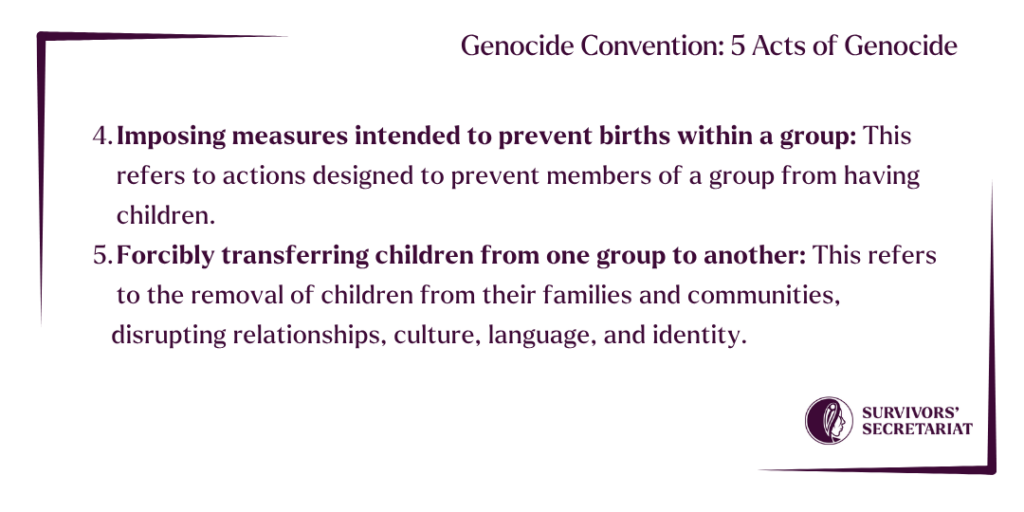
A slide from Genocide in Canada, co-authored by Professor Fannie Lafontaine and the Native Women’s Association of Canada, provides context on how international legal frameworks can be applied to understand the historical and ongoing impacts of colonial policies in Canada.
In examining Canada’s treatment of Indigenous Peoples, the Tribunal heard the Prosecution’s arguments, presented by Lead Prosecutor Christa Big Canoe of Aboriginal Legal Services. The Prosecution outlined patterns of harm arising from colonial laws, policies, and practices, including:
– Indian Residential Schools
– Child welfare systems
– Forced and coerced sterilization
– Enforced disappearances
– Suppression of Indigenous languages and cultures
– Displacement from lands
– Discriminatory healthcare practices
– Policing Surveillance
– Land Dispossession
– The Indian Act
These laws and systems imposed by the colonial government were examined not as isolated events, but as interconnected systems that have operated over generations, and continue to operate to this day. Laura Arndt, Survivors’ Secretariat Lead says, “We’re living in one of the wealthiest countries in the world, a country known for human rights, and yet here we are talking about a legacy that’s over 200 years old and, in many ways, is still happening systemically through different services and systems.”
Understanding these harms as both historical and ongoing was central to the Tribunal’s examination of the evidence. Lafontaine explained that international law offers different legal frameworks for assessing such patterns of harm. While some actions may be examined through the lens of genocide, others may also be considered within the framework of crimes against humanity.
To read the Prosecution’s full Indictment, which provides an overview of the allegations, supporting evidence, and legal arguments presented to the Tribunal, click here.
Crimes Against Humanity
Lafontaine also discussed the concept of ongoing violations, explaining that certain crimes continue until they are resolved. She identified enforced disappearances, recognized under the Rome Statute as crimes against humanity, as a clear example of a continuing violation because the harm persists when families do not know the fate or whereabouts of their loved ones.
While genocide focuses on the intent to destroy a protected group, crimes against humanity focus on widespread or systematic attacks against civilians. Crimes against humanity does not require proof of the intent to destroy a group.
The Tribunal also heard testimony from Kimberly Murray, former Independent Special Interlocutor for Missing Children and Unmarked Graves and Burial Sites associated with Indian Residential Schools.
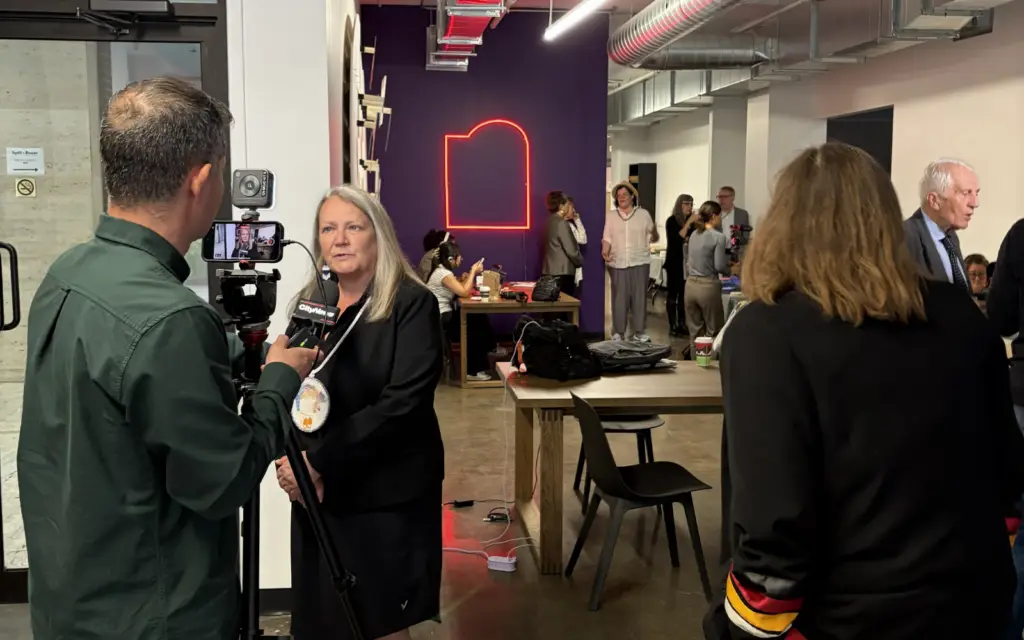
Kimberly Murray, former Independent Special Interlocutor for Missing Children and Unmarked Graves and Burial Sites associated with Indian Residential Schools, speaks with reporters during the Permanent Peoples’ Tribunal on Missing Children and Unmarked Graves and Burial Sites in Montréal, May 2026.
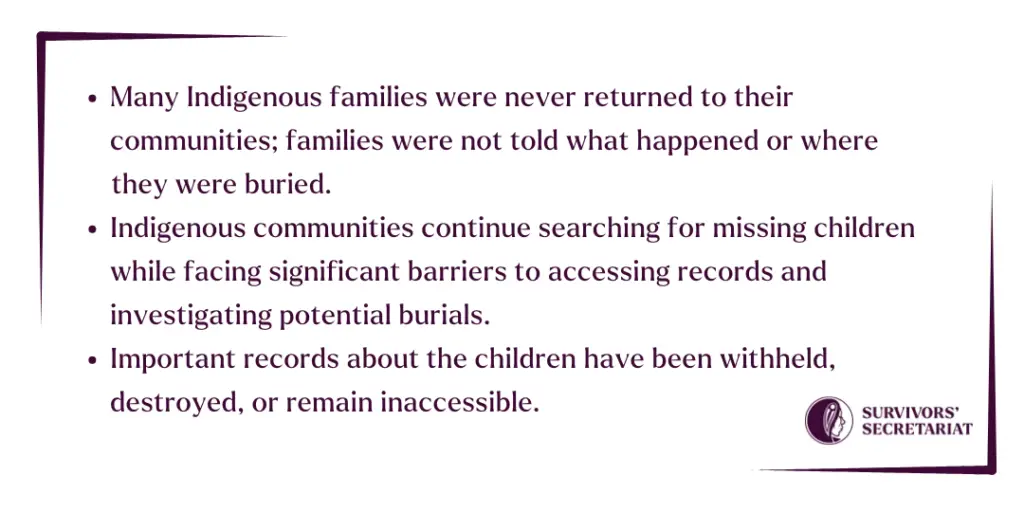
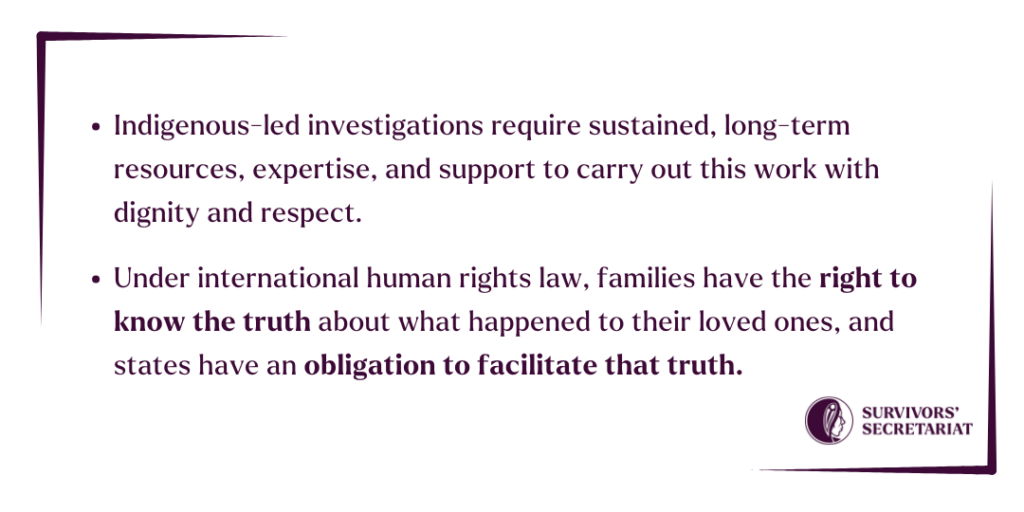
She explained that forced transfer of Indigenous children in the IRS system can also be examined through this lens. When individuals are removed from the place and community where they legally belong and are not returned or their fate remains unresolved, the violation continues. The passage of time does not erase the harm; instead, the ongoing uncertainty about their whereabouts and concealment of truth continues the violation.
Murray identified several factors that contribute to this ongoing harm:
In one of the most powerful moments of her testimony, Murray said:
“That crime of enforced disappearance didn’t just happen when the Indian Residential Schools were operating. I say it’s continuing to happen because we still don’t know the fate of the children. We still don’t know where they are buried. We still don’t have access to the records. It happened yesterday, it’s happening right now as you sit in this room, and it’s going to happen tomorrow.”
Colonial Systems, Indigenous Governance, and the Right to Self-Determination
Building on discussions about the impacts of colonial policies and systems, PPT judge Katsi’tsakwas Ellen Gabriel, spoke about the ongoing impacts of colonial laws and systems of Indigenous governance.
Gabriel discussed the impact of the various amendments to the Indian Act in the 1920’s where the Canadian government withdrew recognition of the Hereditary Haudenosaunee Confederacy Chiefs Council and established an elected council structure. She explained that these policies continue to affect Indigenous Nations today, as hereditary and traditional governance systems that existed before the creation of Canada, remain excluded from many present-day negotiations, while governance structures imposed under the Indian Act remain the primarily governments recognized by Canada. Other significant changes include the 1920 amendment requiring compulsory residential schooling and forced enfranchisement and the Section added 141 sections, making it illegal for First Nations groups or individuals to raise funds or hire legal counsel to pursue land claims without government consent.
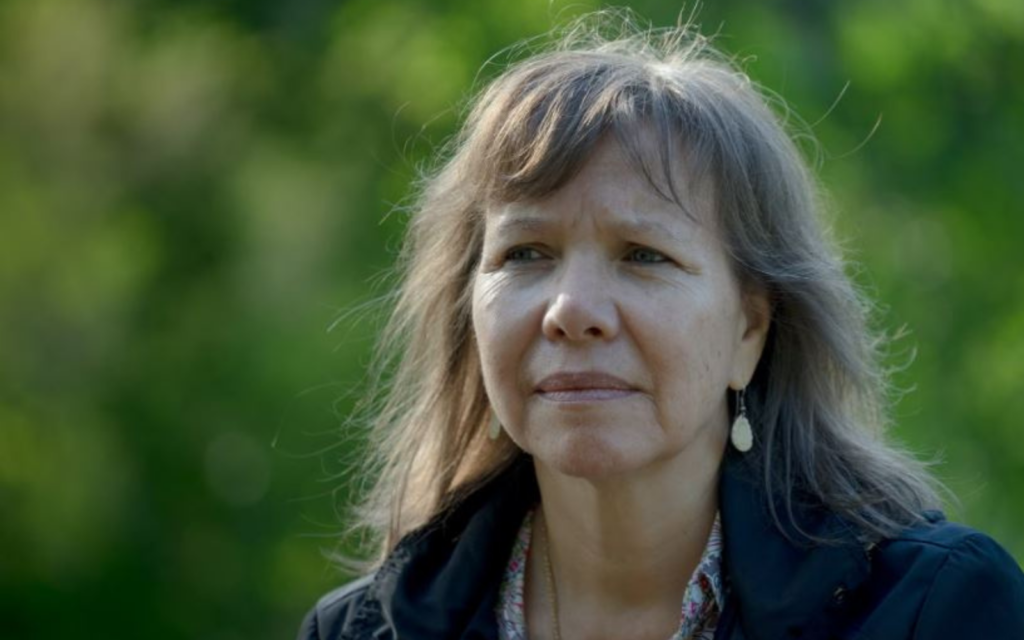
Katsi’tsakwas Ellen Gabriel, Kanien’kehá:ka activist, artist, and human rights advocate. Photo Cred: David Suzuki.org
Gabriel also spoke about the creation of the reserve system and the ways in which colonial policies displaced Indigenous Peoples from their lands, restricted their authority and jurisdiction, and ways of life that have sustained Indigenous Nations since time immemorial. She spoke about the experiences of Indigenous land defenders and the criminalization and surveillance they have faced while advocating for the protection of Indigenous lands and rights. Surveillance by the RCMP of Indigenous advocates was confirmed early this year by CBC reporter Brett Forester after several years of freedom of information requests.
Drawing from her own experience as a spokesperson during the 1990 Kanien’kehá resistance at Kanehsatà, commonly known as the Oka Crisis, Gabriel discussed the ways Indigenous land defenders have been portrayed and monitored by state authorities. She further shared that, through a Freedom of Information request, she discovered information indicating that she had been placed on a terrorist watch list, raising broader concerns about the surveillance and treatment of Indigenous Peoples and those defending Indigenous lands.
These systems affected not only political authority, but also the cultural, spiritual, and community foundations that define Onkwe’hon:we Peoples. Through the ongoing impacts of past and present state policies and institutions, Indigenous Peoples have faced continued efforts to disrupt relationships with their lands, languages, cultures, governance systems, and ways of life. These impacts have shaped the ability of Onkwe’hon:we Peoples to fully exercise and maintain their identities, traditions, and inherent rights.
The Tribunal heard similar concerns regarding the imbalance of power between Indigenous Nations and government institutions. Including, Lafontaine who spoke about the importance of redress and the need for reconciliation of colonial harms to be guided by Indigenous Peoples. She explained that repairing these harms requires more than acknowledging past wrongs; it requires restoring rights, addressing power imbalances, and respecting Indigenous Peoples’ inherent right to self-determination.
Naming the Truth and Moving Toward Accountability and Repair
Throughout the proceedings, one message remained clear: naming genocide and crimes against humanity is not simply about applying legal terminology. It is about recognizing historical truth, confronting denialism, and creating pathways toward accountability.
Throughout her testimony, Professor Fannie Lafontaine emphasized that using the correct legal language is an important step toward understanding the nature of the harms experienced by Indigenous Peoples. Naming these crimes helps move public discussion beyond misconceptions and encourages a deeper understanding of Canada’s colonial history and its ongoing impacts.
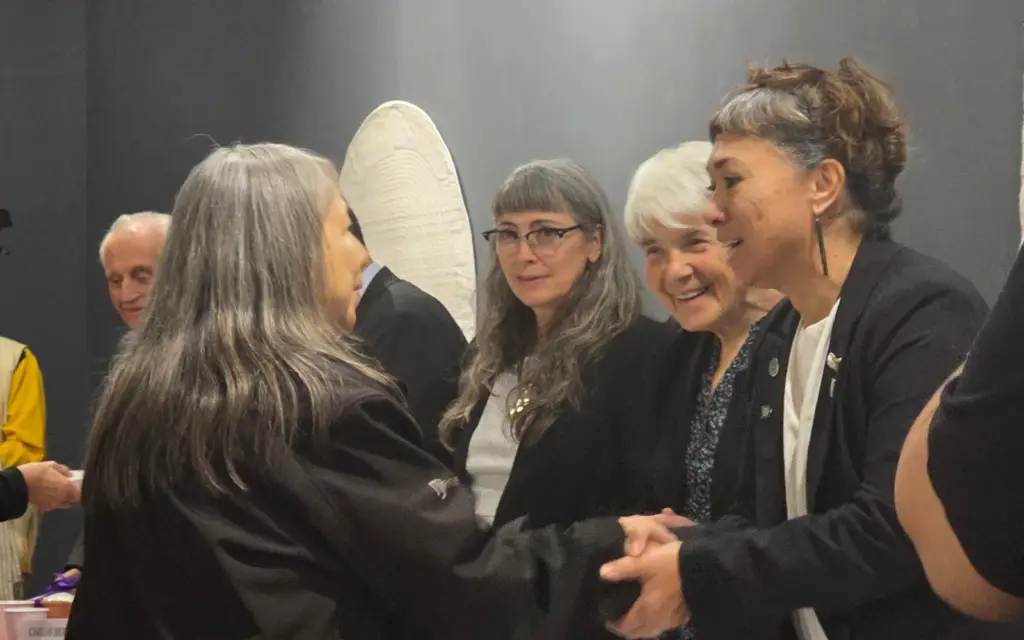
Mohawk Institute Survivor and Survivors’ Secretariat Board Member Sherlene Bomberry express her gratitude to the judges of the Permanent Peoples’ Tribunal on Missing Children and Unmarked Graves and Burial Sites following the Montréal hearings, May 2026.
For many Canadians, concepts such as Indigenous rights, genocide, crimes against humanity, and international human rights law remain unfamiliar to many or are not fully understood. The Tribunal demonstrated that increasing public awareness is not about creating Indigenous rights or validating them through public opinion, as those rights already exist under international law, and should be respected.
The Tribunal's Preliminary Findings
Following five days of Survivor testimony, expert evidence, and legal submissions, the distinguished panel of judges of the Permanent Peoples’ Tribunal issued a preliminary declaration concluding that the evidence presented throughout the week, which established that Canada had committed genocide against Indigenous Peoples and crimes against humanity under international law.
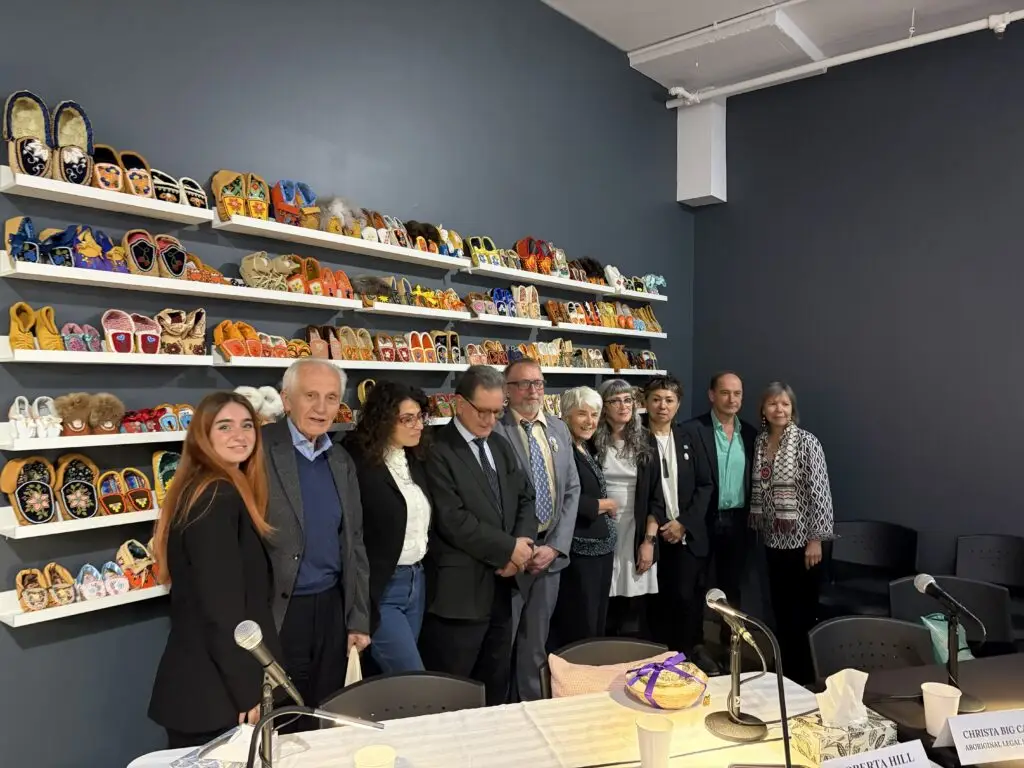
The distinguished panel of judges listens as Survivors, families, experts, and witnesses share testimony during the Permanent Peoples’ Tribunal on Missing and Disappeared Indigenous Children and Unmarked Burials in Montréal, May 2026
The co-chair of the tribunal, Frances Webber, stated that “So there is no difficulty for us to accept that composite pattern constituted genocide. There is no difficulty accepting that the crimes towards Indigenous peoples; enforced disappearances, torture, sexual violence, enslavement, persecution, and other inhumanes and omissions such as failure to provide safe and healthy living conditions systemically applied to indigenous children, women and families constitute crimes against humanity according to customary international law. All of this is known, it has been heard before, but it continues.”
The preliminary declaration also stated that: “Canada continues to destroy Indigenous lives, community and family structures, culture and identity through the ongoing forced removal of children from their parents……and continues to condone the sterilization of women without consent through failure to enforce criminal laws of assault.
The judges further concluded that: “Colonial attitudes persist in the continuing encroachment on Indigenous lands for extractive activities that pollute lands, render lands uninhabitable and cause illness; and in the failure to provide adequate health care and clean water to Indigenous communities. Adding insult to injury, Indigenous land defenders are surveilled and prosecuted.”
For Roberta Hill, a Survivor of the Mohawk Institute and a Survivors’ Secretariat Board member, the preliminary declaration offered an important acknowledgement of what Survivors have been saying for generations. “Survivors have been standing up for a long, long time, trying to get people to understand and listen to us,” she said.
Reflecting on the judges’ findings, Hill added, “This is something that [pause] it gives me hope. It’s a long, long journey.” Her words recognized both the significance of the declaration and the long road that remains toward truth, justice, and accountability.
Although Canada received formal notice of the proceedings, it chose not to participate or present a defense. Throughout the hearings, an empty chair remained in the hearing room as a visible reminder of the Canadian state’s absence:

An empty chair representing Canada’s absence from the Permanent Peoples’ Tribunal proceedings in Montreal, May 2026.
The Permanent Peoples’ Tribunal’s final report and recommendations will be released on September 30, 2026, at 9:30 a.m. online at www.our-truths.com and shared with the Canadian government and the Vatican.