
On May 27, 2026, Survivors’ Secretariat Lead Laura Arndt and archaeologist Dr. Scott Hamilton testified before the 57th Session of the Permanent Peoples’ Tribunal on Missing and Disappeared Indigenous Children and Unmarked Graves in Canada. Drawing on the Survivors’ Secretariat’s mandate to Uncover, Document and Share the history of the Mohawk Institute Indian Residential School, they described the extensive research, expertise and resources needed to investigate former residential school sites.
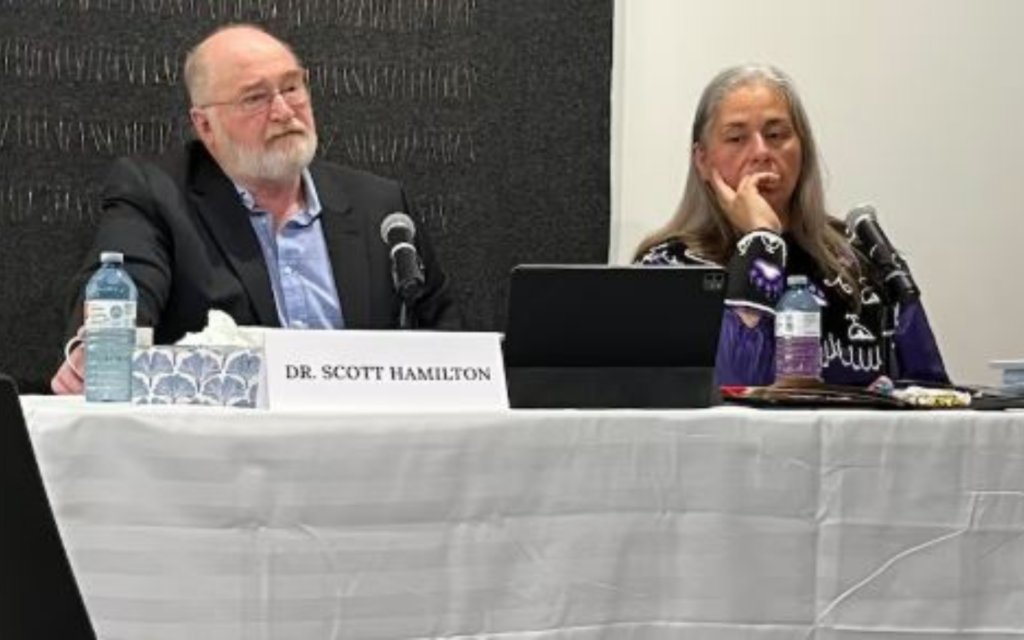
Dr. Scott Hamilton (left) and Laura Arndt testify at the Permanent Peoples’ Tribunal on Missing and Disappeared Indigenous Children and Unmarked Graves in Canada, held in Montreal in May 2026. Photo credit: Joy Spear Chief-Morris via CBC.
Arndt and Hamilton stressed that delays in investigations do not reflect a lack of effort or commitment from Survivors and Indigenous communities. They emphasized that timely and sustained federal funding is essential to keep investigations moving forward and find answers about the children who never returned home. “Many Survivors are now in their eighties and nineties and want answers within their lifetimes.”
In this blog, we will discuss what their testimony revealed about the barriers facing the Survivors’ Secretariat and other Indigenous-led investigations and why the Permanent Peoples’ Tribunal (PPT) Judge and Co-Chair Frances Webber described this pattern as a “war of attrition.”
The Moment The Pattern Was Named
During their testimony, Survivors’ Secretariat Lead Laura Arndt described the consequences of financial instability for the organization: it lost experienced staff, suspended keys parts of its work, and had to repeatedly rebuild its capacity. Dr. Scott Hamilton placed the Secretariat’s experience within a broader pattern affecting Indigenous-led investigations across Canada.
Dr. Hamilton is a Professor Emeritus in Anthropology at Lakehead University who began examining Indian Residential School deaths and burial sites as a researcher for the Truth and Reconciliation Commission. He now advises the Survivors’ Secretariat and other Indigenous communities investigating missing children and unmarked burials.
During his testimony he described the insurmountable task place upon Indigenous-led investigations to navigate, fund, and build capacity to undertake the complex task of identifying disappeared children, tracing burials information tied to known child deaths, and identifying potential unmarked burials associated with the institutions they are investigating.
Near the end of their testimony, PPT Judge Frances Webber asked why work of such vital importance was being left without sufficient and dependable support. Dr. Hamilton said he had initially considered explanations such as administrative incompetence, competing government priorities, or the short attention span of a political news cycle. However, after hearing similar accounts from investigations across the country and watching Survivor-led organizations spend their limited capacity navigating what he called a “paper chase,” he came to fear that something larger was happening: a flood of changing rules and administrative delays exhausting communities until they were forced to yield the field.
Judge Frances Webber asked: “So, a war of attrition?”
Dr. Hamilton responded: “The war of attrition.”
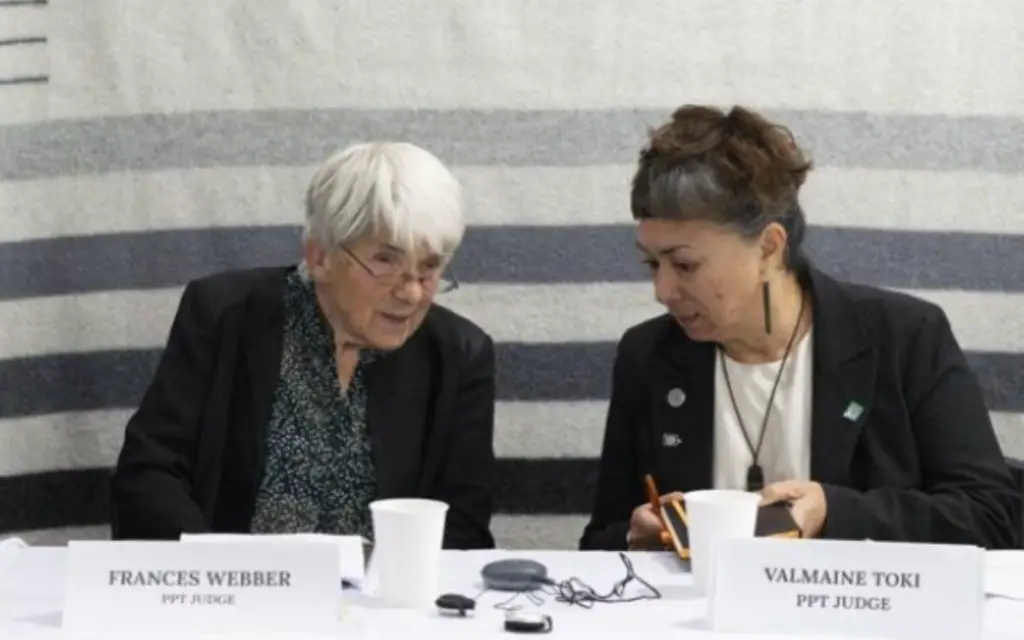
Judges Frances Webber (right) and Valmaine Toki deliver the preliminary statement at the Permanent Peoples’ Tribunal on Missing and Disappeared Indigenous Children and Unmarked Graves in Canada, held in Montreal in May 2026. Photo credit: Christine Muschi/The Canadian Press.
A war of attrition does not depend on one decisive act. It works through repeated obstacles that drain time, resources, staff, and momentum. In these investigations, attrition takes the form of short-term funding, shifting program rules, late approvals, incomplete records, unanswered questions, and the constant need to rebuild capacity. Each disruption makes it harder to sustain the long-term work needed to find answers.
An Immense Search With Limited Resources
Imagine being handed a map showing one hundred possible locations, but many landmarks have disappeared, buildings have moved, and entire sections of the map are missing. Each location requires archival research, Survivor knowledge, cultural protocols, land access permissions, technical surveys, careful analysis of data collected, and sometimes, several different investigative methods. Every decision about where to search also becomes a decision about which areas must wait.
Dr. Hamilton further expressed that ground-penetrating radar (GPR) is only one part of this work. Its results are affected by many variables including soil conditions, moisture levels, climate, and earlier disturbances to the land. He stressed that data collected at one site cannot be interpreted in exactly the same way as data from another due to these variables. He also shared that each investigation can produce an immense amount of technical information that must be securely stored, reviewed, and interpreted by experts, which are extremely expensive and time-consuming tasks.
When funding is cut before that work is complete, searches are suspended, staff or expert capacity moves on, expensive software and hardware is not being used, storage costs since incur, and data remain only partly analyzed.
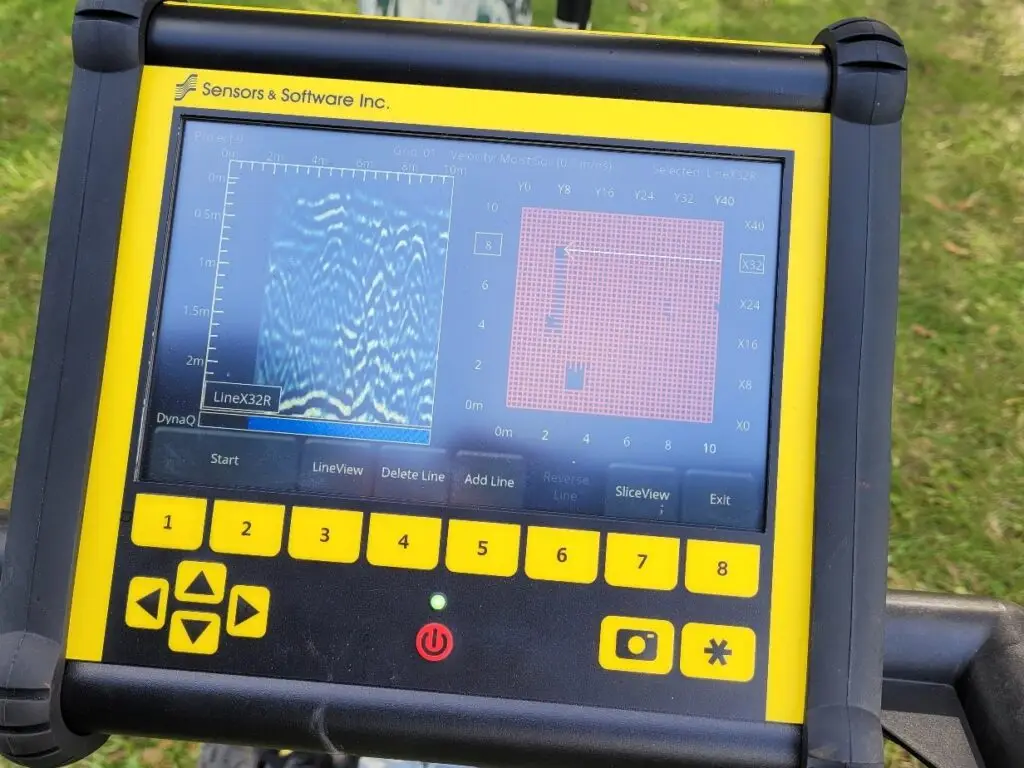
Ground-penetrating radar (GPR) equipment used to collect data along a marked grid, helping researchers identify features beneath the ground that may require further investigation.
Across Canada, Indigenous communities are conducting investigations at many former Indian Residential School sites. Organizations leading these investigations have been expected to build their own capacity from the ground up while competing to retain the limited number of specialists who are able to inform this work, all while navigating short-term funding agreements. The result is a vast amount of work and data spread across the country without long-term support.
Indigenous communities do have the right to lead this work, however they must be supported by sustained resources, shared technical capacity, and secure, Indigenous-controlled systems for preserving data. The current model of annual funding applications, that close 6 months into the fiscal year, and are often not approved until the early or even late winter are not conducive to ground search investigations, as much of the fieldwork must take place during the spring, summer and early fall. As Arndt and Dr. Hamilton described funding decisions can arrive in September, October or even December, after much of the ground-search season has passed.
In some cases, organizations are left with only weeks or days to use funding before the end of the fiscal year. This was the case with Survivors’ Secretariat’s 2025-2026 funding application, which received approval for $1.9 million of funding on March 29, 2026, with only two days remaining in the fiscal year. When they asked how they were expected to spend those funds in that window, CIRNAC representatives responded with, “why didn’t you do all the things in your application.” To which Arndt responded, “because we had no money to pay anyone.”
The Secretariat was able to maintain some of its core operations through loans, negotiated extended payment terms, and a grant from their local First Nation. They were also able continue some initiatives which had project-specific funding such as the development of the Stolen Childhoods mobile exhibit. However, the funding delayed made it difficult to retain staff and keep up employee morale, schedule specialists responsibly, and continue their investigation.
The danger identified in the testimony, is that Canada can outlast Survivor-led investigations, not by formally ending them, but by spreading limited resources too thinly, delaying support and forcing organizations to repeatedly start over, which enhances the harms experienced by Survivors and intergenerational Survivors who are constantly met with disgusting and inexcusable demands to “dig them up” or provide additional proof from denialist. If that pressure continues long enough, exhausted Survivors and investigative teams may be left with no practical choice but to “yield the field.”
How Funding Uncertainty Becomes Attrition
Created in 2021, the Survivors’ Secretariat originally requested approximately $24 million to carry out its work. Arndt testified that Canada provided $10.5 million over the organization’s first three years. That funding allowed the Secretariat to hire staff; establish its four pillars of Ground Search, Document Collection, Advocacy and Commemoration; begin reviewing records; hold Survivor gatherings; and lay the foundation for a memorial park and a community-controlled archive.
When the Secretariat applied for funding for 2024–25, that support was not renewed at a comparable level. Arndt testified that the organization was initially told the program ceiling would be $500,000 per year and that some activities central to its investigation, such as “invasive archeology” would no longer be eligible. The Secretariat then travelled to Ottawa to oppose the decision and advocate for sustained funding.
Following that advocacy and a personal visit from the Minister of CIRNAC, the Secretariat was verbally offered $3 million in funding. Arndt testified that Survivors were concerned this funding would be taken from money available to other Indigenous communities conducting similar investigations. The Secretariat did not want their work funded at the expense of other communities; so, they continued to publicly advocate for additional funding to be added to the Indian Residential Schools Community Support Fund.
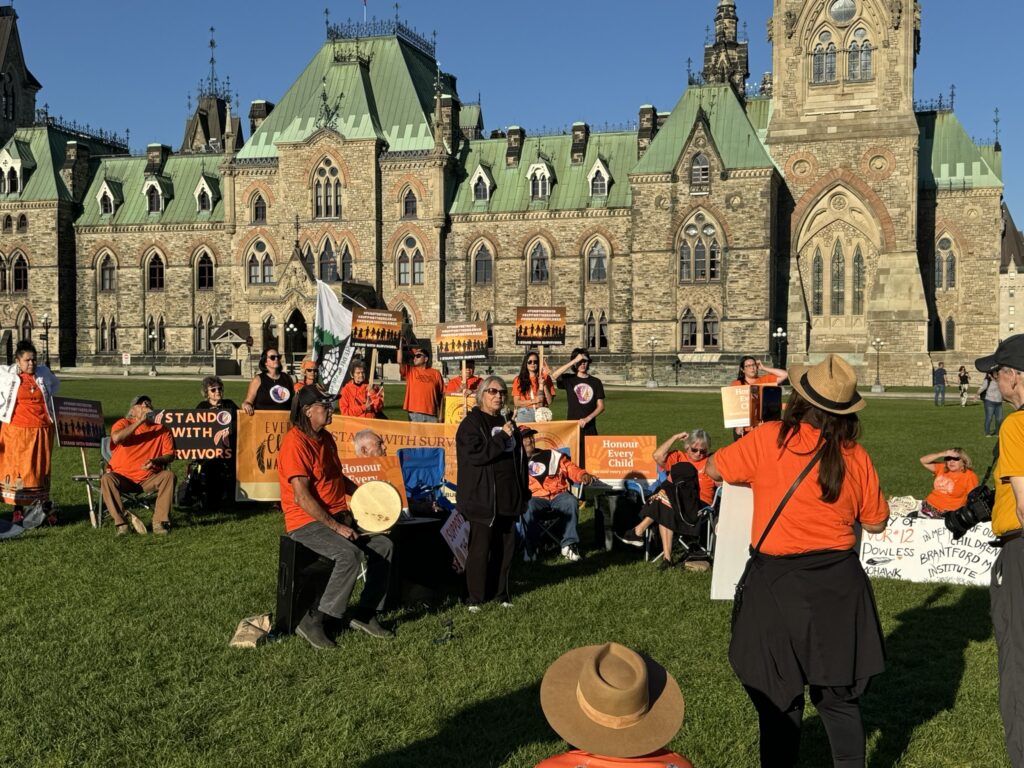
Survivors, Survivors’ Secretariat representatives and allies gather in Ottawa on July 22, 2024, to oppose funding cuts and call for increased support for searches for missing children who never returned home from Indian Residential Schools.
The federal government later informed the Secretariat that it would receive no new funding for the 2024–25 fiscal year, citing that their records indicated the organization had approximately $3 million in carry-over funds and that their audits were not submitted, despite having held public annual general meanings and publishing audited financial statements on their website.
Arndt testified that federal officials eventually confirmed there were no concerns with the Secretariat’s audits. However, by that time, the application window had closed, and the Secretariat was told it was too late. However, the Secretariat did have a carryover from the 2021-2023 agreement that resulted from funding not flowing to the organization until January of 2024, with only three months remaining in the fiscal year and well after the ground search season ended.
The consequences were immediate. As its carry-over funding diminished, the Secretariat was forced to lay off investigators, human rights monitors, and community staff, bringing work across its four pillars to a near standstill. Arndt described this period as one of “paralysis.” She stopped drawing a salary and used her personal savings to help keep the organization operating. Provincial and charitable support kept the Secretariat from becoming insolvent, but it could not restore the staff, capacity and momentum that had been lost. This is how funding uncertainty becomes a form of attrition: the work is never formally ended, but the conditions required to continue the work are steadily taken away.
When Delay Feeds Denialism
The harm does not end with delayed work. Funding cuts also create an opening for residential school denialism. When governments announce that investigations are a priority and then reduce, delay or sunset fundings, denialists use that retreat to claim there is nothing to investigate.
Dr. Hamilton described researchers and community members having to face harassment, threats, and damage to property. Survivors and their grandchildren see their truths publicly challenged. Some organizations stated they had to reduce communications because any update can be taken out of context.
This does not advance evidence-based debate. It obscures the work and re-enforces a narrative that Survivors prove their own lived experiences to institutions and denialists that have already decided not to believe them. When communities are forced to spend their time responding to denialism instead of advancing investigations, denialism becomes another form of attrition.
The Tribunal’s preliminary statement connected these issues directly. It stated that Canada’s withholding of resources needed to investigate unmarked burials has fueled denialism and public skepticism. It also recognized the scale of the work described by Arndt and Dr. Hamilton, the lack of full access to government- and church-held records, and the need for long-term, sustainable funding.
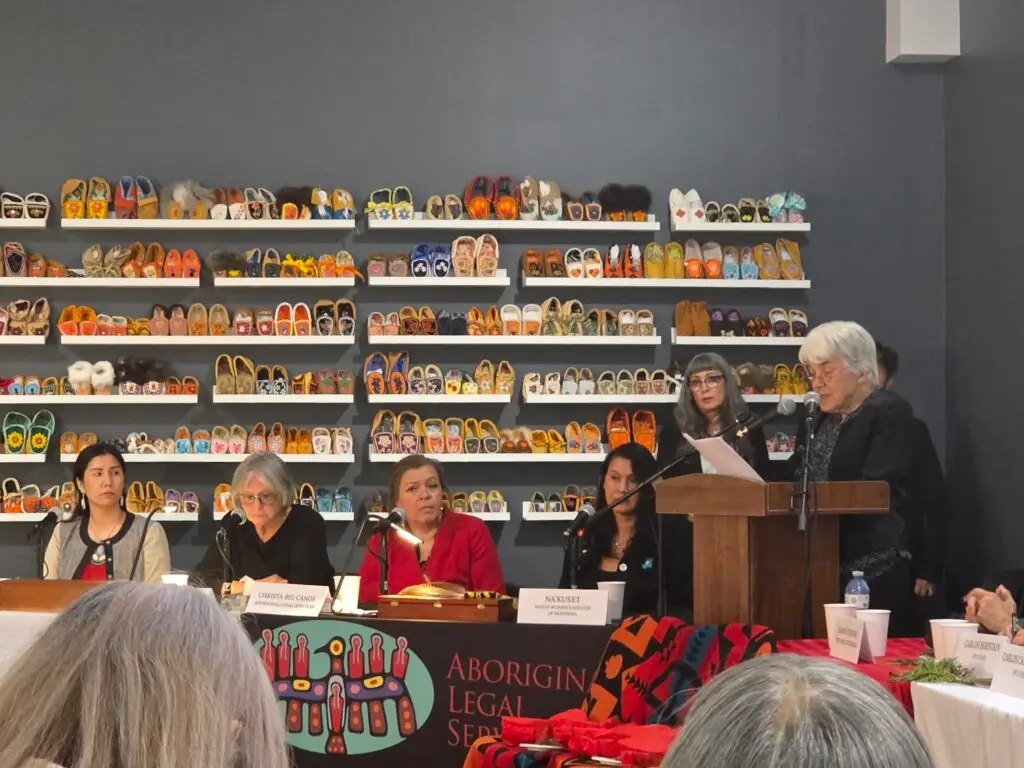
Co-chair Frances Webber reads the interim statement on the final day of the Permanent Peoples’ Tribunal hearings in Montreal, May 2026.
The judges emphasized that the absence of information and investigation causes continuing psychological and collective harm, obstructs grieving and healing, and deepens mistrust in the Canadian state. These are not historical harms sealed in the past. They are renewed whenever a family is denied an answer, a search season is lost, a Survivor’s truth is attacked, or a community is told to wait again.
Canada must not wait out the people to whom it owes the truth. Records must be opened, resources must arrive when they can be used, and the work must remain under the leadership of Survivors and communities. Every child deserves to be named, remembered and brought home, and every Survivor deserves answers within their lifetime.
On September 30, 2026, the National Day for Truth and Reconciliation, the Permanent Peoples’ Tribunal will deliver its final judgment on Missing and Disappeared Indigenous Children and Unmarked Graves in Canada.
The final judgment will mark an important moment in the ongoing pursuit of truth, accountability, and justice. We invite everyone to listen, learn and stand with Survivors and communities who continue to seek answers about the children who never returned home. Watch the livestream at 9:30 a.m. ET at our-truths.com
Blog Written by Crystal L. Castellan, edited by Tabitha Curley