
Indian Residential School records are not simply “data.” They hold memory, evidence, and the history of a system that removed children from loving families and communities. Many families were denied information about where their children were, how they were being treated, whether they had become sick, or whether they had died. Many of the children who returned home carried the harms of the system throughout their lives as “Survivors.”
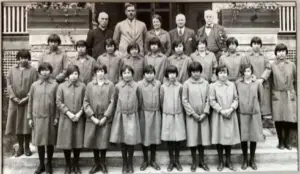
Historical photograph of children outside the Mohawk Institute Indian Residential School (“The Mush Hole”). Image courtesy of the London Metropolitan Archives.
Historical photograph of children outside the Mohawk Institute Indian Residential School (“The Mush Hole”). Image courtesy of the London Metropolitan Archives.
For some children, institutional records may provide the only surviving written evidence of what happened to them. These records may also contain critical clues about where children were sent, how they were treated, when they became ill, whether they died, and what information was withheld from their families.
This blog explains why Indian Residential School (IRS) records matter, the barriers Indigenous communities continue to face in accessing them, and how Indigenous Data Sovereignty, Indigenous Data Governance, and the principles of OCAP guide the Survivors’ Secretariat’s work.
Our History and Our Records
Indigenous history belongs to Indigenous Peoples. That includes the experiences of generations of Indigenous children who were taken to Indian Residential Schools.
Every record, report, and piece of correspondence created during the operation of these schools tells part of their story. Yet families, communities, and Nations are still forced to navigate colonial systems that restrict access to these records. These barriers deny us vital information about what happened to the children who were taken from their families, many of them by force, and prevent us from fully understanding and documenting our own history.
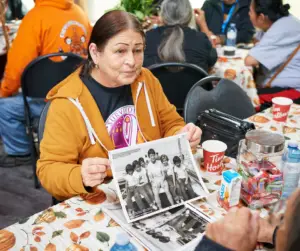
Survivors’ Secretariat Board Member and Survivor Diane Hill reviews historical photographs of children who attended the Mohawk Institute Indian Residential School, supporting ongoing truth-telling and research efforts.
Survivors’ Secretariat Board Member and Survivor Diane Hill reviews historical photographs of children who attended the Mohawk Institute Indian Residential School, supporting ongoing truth-telling and research efforts.
Records associated with the Indian Residential School system hold the lived experiences, histories, and truths of an estimated 150,000 Indigenous children who were taken to these institutions across Canada. In the case of the Mohawk Institute Indian Residential School, records confirm that at least 6,200 individual children were taken there during its more than 140+ years of operation.
Accessing and reviewing these records is connected to a promise made to Indian Residential School Survivors by the federal government: to bring the children home.
Bringing the children home means restoring their names, histories, identities, and records to their families, communities, and Nations. Today, this responsibility continues to be carried forward by Survivors, their families, intergenerational Survivors, and those entrusted to support the work under Survivor leadership.
The Survivors’ Secretariat’s Archival Work
At the Survivors’ Secretariat, we conduct archival research under the leadership of Indian Residential School Survivors. Our goal is to identify every child who attended the Mohawk Institute and gather information that may help determine what happened to children who remain missing, disappeared, or unaccounted for.
Through this research, we are searching more than 150 databases within and outside Canada for records connected to the Mohawk Institute. To date, the Survivors’ Secretariat has collected more than 37,000 records from 50 of those databases.
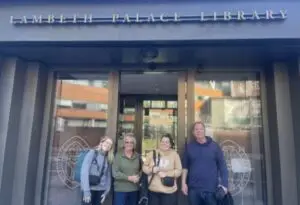
Survivors’ Secretariat board member Roberta Hill, Know History Historical Research Team members Beth Solis and Jennifer Bate along with Mark Pritchard, the Secretariat’s Investigative Advisor, travelled to England to access records held at the Palace Archives at Lambeth Library.
Survivors’ Secretariat board member Roberta Hill, Know History Historical Research Team members Beth Solis and Jennifer Bate along with Mark Pritchard, the Secretariat’s Investigative Advisor, travelled to England to access records held at the Palace Archives at Lambeth Library.
This work requires ongoing guidance from Survivors and an understanding of provincial and federal access-to-information laws. These laws determine which records may be accessed, how requests must be made, and what restrictions may be imposed. Those restrictions can affect our ability to gather information about the children taken to the Mohawk Institute and the people involved in its operation. Even when records are made available, access agreements may prevent us from sharing copies with Survivors, families, or communities.
Our goal is to bring these records under Indigenous protection, stewardship, and control. Doing so requires a clear understanding of Indigenous Data Sovereignty (the right of Indigenous Peoples to govern information about themselves) and Indigenous Data Governance (the structures and responsibilities used to exercise that right).
How IRS information is protected, governed, interpreted, and used is critically important. These records contain sensitive personal information about the children who attended and may carry legal, cultural, historical, and emotional significance for Survivors, families, and communities.
What Indigenous Data Sovereignty Means
Contemporary national discussions about Indigenous data governance were significantly advanced by the 1996 report of the Royal Commission on Aboriginal Peoples. The report recommended that First Nations, Inuit, and Métis leaders develop their own capacity to collect, maintain, analyze, and govern information about their Peoples and communities. It also called for shared strategies to support Indigenous-controlled databases and data systems. This report ultimately contributed to the establishment of the principles of OCAP in 1998 and, later in 2000, the creation of the First Nations Information Governance Centre.
Indigenous Data Sovereignty is the right of Indigenous Peoples to govern information about their Peoples, communities, lands, cultures, histories, and experiences. It recognizes that Indigenous Peoples have the authority to determine how this information is collected, accessed, interpreted, protected, shared, and used.
Indigenous Data Governance is how that right is exercised in practice. It includes the policies, responsibilities, decision-making structures, and standards established to ensure information is managed in a respectful, secure, culturally grounded, and accountable way.
OCAP stands for Ownership, Control, Access, and Possession. These principles provide a framework for how First Nations and Indigenous information is collected, protected, accessed, shared, and used.
In simple terms, Indigenous Data Sovereignty is the right. Indigenous Data Governance is how that right is exercised and OCAP provides principles that help First Nations put both into practice.
Building the Survivors’ Secretariat Community Archive
The Survivors’ Secretariat created its Community Archive to securely house the records collected through its research into the Mohawk Institute and house the memories of the children who once attended. Developed alongside Animikii, an Indigenous technology company, the Community Archive is guided by OCAP principals, Indigenous Data Sovereignty, Indigenous Data Governance, and the work of Indigenous data leaders in Canada and internationally.
Applying OCAP helps put Indigenous Data Sovereignty and Indigenous Data Governance into practice. It also demonstrates that Indigenous organizations can manage sensitive records according to culturally grounded standards of care, responsibility, and accountability. Its purpose is to protect, preserve, and responsibly steward IRS records associated with the Mohawk Institute for Survivors, families, communities, and future generations.
However, this work is far from complete with many repositories still not reviewed and with more than 27 million additional Indian Residential School records still being held by the federal government. This is further complicated as information connected to the Indian Residential School system is scattered across church archives, federal repositories, private collections, and institutional databases. This fragmentation makes it more difficult for Survivors, families, and communities to access information about their own histories.
As Mohawk Institute Survivor Geronimo Henry explained:
“We need an archive, a building, a place where future generations can learn exactly what happened. So no one can ever say it didn’t.” —Geronimo Henry, Mohawk Institute Survivor, 1942–1953
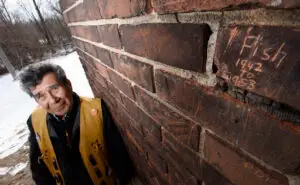
Geronimo Henry with his name Fish, top right, scratched into a brick at Woodland Cultural Centre in Brantford.
(Hamilton Spectator, John Rennison)
Geronimo, a Mohawk Institute Survivor, stands where as a young man he carved his nickname ‘Fish’ and the years he attended the school ( 1942–1953), into the bricks of the Mohawk Institute.
Why Indigenous Stewardship Matters
For generations, Indigenous knowledge and cultural heritage have been collected, recorded, or taken by governments, institutions, and researchers, without consent.
Records from Indian Residential Schools were not created for the benefit of Indigenous children or their families. The information recorded about the children was not collected to protect their well-being or serve the needs of their families and communities. It was recorded from an institutional and colonial perspective that excluded Indigenous voices, cultures, knowledge, and lived experiences. These records were created by administrators, clergy, government officials, and others involved in operating and overseeing the system. As a result, many of these records reflect government policies of control and assimilation. They may describe Indigenous children through negative stereotypes rather than recognizing them as children with families, cultures, identities, rights, and dignity.
Because these records were created within the system that harmed the children, they do not tell the whole story. They must be read critically and interpreted alongside Survivor testimony, Indigenous knowledge, family histories, community records, and the broader context of colonial policy. Indigenous stewardship is therefore not only about where records are stored. It is also about how they are understood, protected, interpreted, and used.
Through our work to uncover, document, and share the truth, the Survivors’ Secretariat remains committed to bringing the children home. That work requires bringing the records connected to their lives back under Indigenous care and authority. Many of the records collected by the Survivors’ Secretariat contain names, personal histories, medical information, and other sensitive details about children who were taken to the Mohawk Institute. In many cases, organizations that provide access to records place significant restrictions on how the information can be stored, used, or shared. This demonstrates why managing and protecting these records responsibly is so important.
Our commitment to Indigenous Data Sovereignty and Indigenous Data Governance includes:
- preserving 140+ years of history connected to the children taken to the Mohawk Institute;
- protecting sensitive personal and cultural information from misuse;
- safeguarding historical evidence and Survivor truths without causing further harm; and
- supporting healing, cultural continuity, self-determination, accountability, and truth-telling.
Although access agreements sometimes prevent us from sharing copies of the records, we remain responsible for protecting the information entrusted to us. Our goal is to establish culturally grounded standards of care, privacy, security, and accountability that meet or exceed those currently applied by Canada and other record-holding institutions. Indigenous ownership, control, access, and possession would allow these records to be governed according to standards grounded in Survivor leadership, cultural responsibility, privacy, dignity, and care.
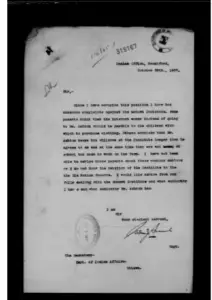
Example of Mohawk Institute records:
Safeguarding Truth for Future Generations
Building the Survivors’ Secretariat Community Archive ensures that these records are preserved and stewarded by Indigenous Peoples in a way that honours the children and protects their information from further exploitation. It recognizes that records about our children, families, and communities should not remain solely under the control of the governments and institutions that created, maintained, or benefited from the Indian Residential School system. The Community Archive also preserves evidence of the purpose and operation of the Mohawk Institute, including the role it played in advancing the colonial policies of Britain and, later, Canada.
Although much work remains, each record gathered, protected, and returned to Indigenous care brings us closer to safeguarding the truth, supporting healing, and ensuring that the stories of the children and Survivors are never forgotten.