
When people hear the term Indian Residential School denialism, they often think it refers to those who deny that Indian Residential Schools existed or question the abuse that occurred within them. While these are forms of denialism, they represent only part of the problem.
Indian Residential School denialism is not only about rejecting a truthful account of what occurred during the Indian Residential School era. It attempts to separate the past from the present by suggesting that the harms ended when the last federally operated school closed.
Although the buildings closed, the harms and their ongoing impacts did not end. Nor did the colonial systems that created them.
When we deny the history of Indian Residential Schools or dismiss Survivors’ lived experiences, we are denying more than what happened decades ago. We obscure the present day realities of colonialism, shield institutions and governments from accountability, ignore Indigenous rights recognized under international law, and shape how present and future generations understand truth, justice, and reconciliation.
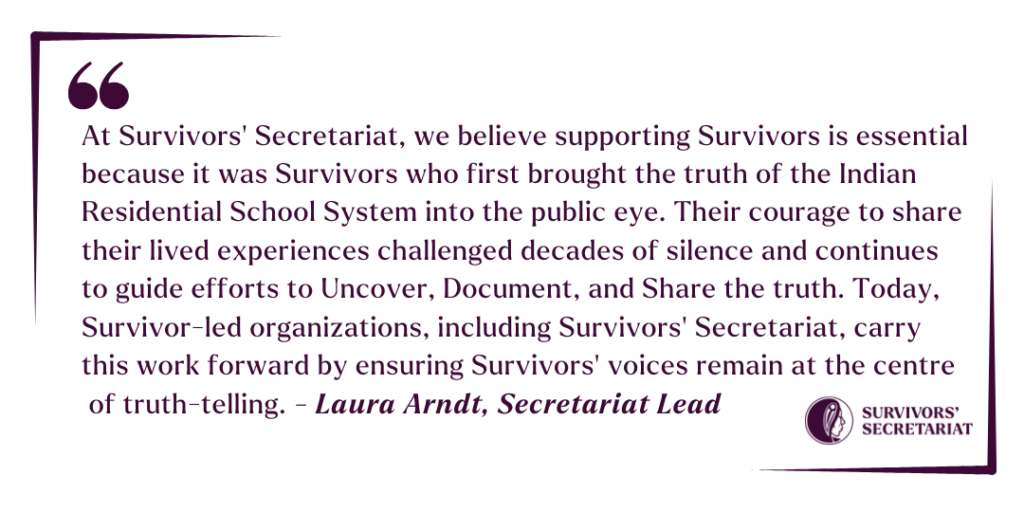
At the Survivors’ Secretariat, Survivors’ voices and lived experiences guide our work. Denying the past obscures the present and shapes the future that generations to come will inherit. Truth is the foundation of reconciliation.
What is Indian Residential School Denialism?
Indian Residential School denialism is the rejection, minimization, distortion, or justification of the documented harms caused by the Indian Residential School System.
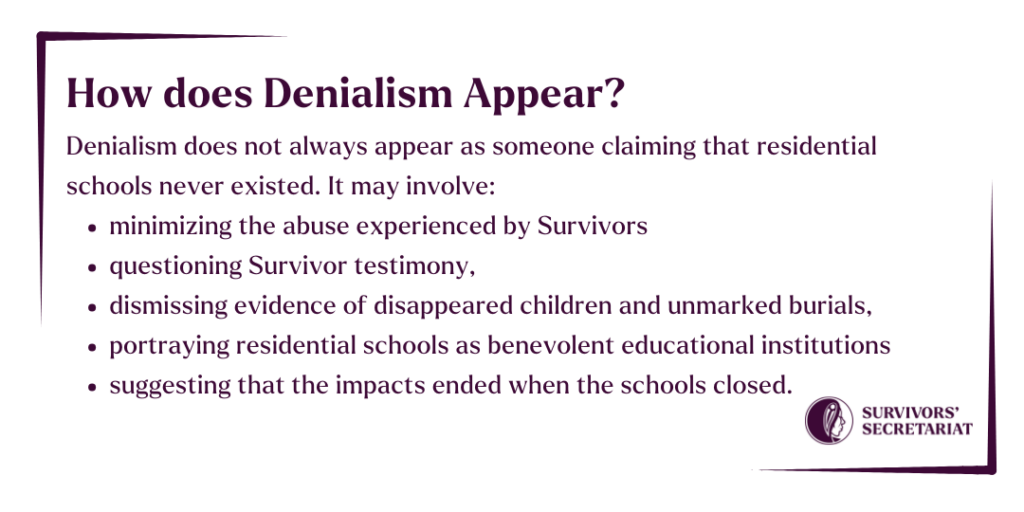
Denialist narratives attempt to reshape public understanding by minimizing Survivors’ experiences and reducing accountability for the governments, churches, and institutions that operated and benefited from the Indian Residential School system. This is dangerous because when governments and institutions are allowed to act without scrutiny or accountability, similar harms can be ignored, repeated, or inflicted on other groups.
For a more detailed discussion of common forms of Indian Residential School denialism and misinformation, click here.
The Truth has been Documented
The history of Indian Residential Schools is not based on a single story, one archive, or one investigation. It is supported nationally by decades of Survivor testimony, government and church records, legal proceedings, academic research, and community-led investigations.
The Truth and Reconciliation Commission of Canada heard thousands of testimonies from Survivors who courageously shared their lived experiences. These testimonies are reinforced by historical records. These records document the federal government’s role in creating and funding the Indian Residential School system, as well as the role of churches in operating many of its institutions. Together, they show that the harms experienced by Indigenous children were not isolated incidents or merely the result of poor policy. The system was deliberately designed and implemented to separate children from their families, Nations, languages and cultures.
The Mohawk Institute Indian Residential School, located in Brantford, Ontario, is one such example. Operating for more than 140+ years, the institution was funded by the federal government and administered by the Anglican Church.
Through archival research, records preservation, and ground searches, the Survivors’ Secretariat is working to Uncover, Document and Share the truths of the Mohawk Institute in it’s 140+ years of operation.
Despite archival evidence, Survivor testimony and ongoing investigations, Indian Residential School denialism persists. This denial does not challenge one isolated account of Canadian history; it rejects a much broader and well-documented truth about colonial systems imposed on Indigenous Peoples around the world.
Indian Residential Schools were a part of a larger Colonial System
Indian Residential School denialism often attempts to portray Canada’s Indian residential school system as an isolated historical event. However, the removal of Indigenous children from their families, suppression of languages and cultures, and disruption of Indigenous identities were part of broader colonial policies used around the world.
During the 57th session of the Permanent Peoples’ Tribunal proceedings, investigative journalist and author Tanya Talaga spoke about Indian Residential Schools within a broader context of colonial violence, displacement, and cultural erasure. In 2009, the United Nations published a comparative study examining Indigenous boarding schools and residential school systems in countries including Canada, the United States, Australia, New Zealand, and others. The study found that, despite differences between countries, these systems shared common goals: assimilate Indigenous Peoples, suppress cultures and languages, weaken Indigenous governance systems, and advance colonial control over Indigenous lands.
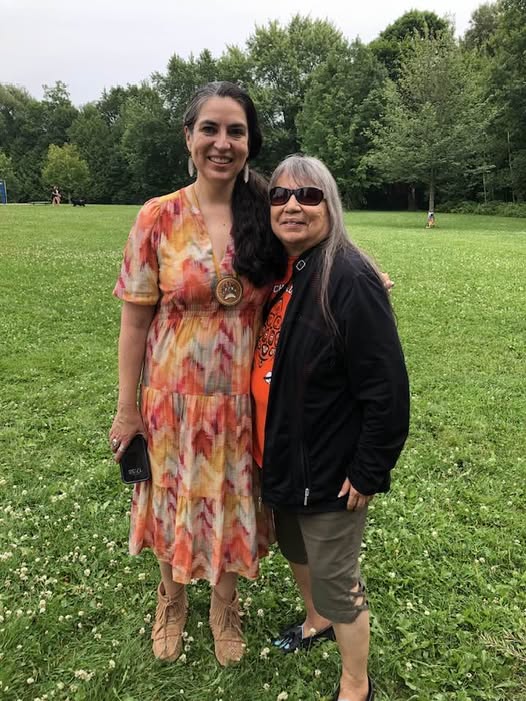
Investigative journalist Tanya Talaga with Mohawk Institute Survivor Sherlene Bomberry
Recognizing these connections challenges denialist narratives that portray Canada’s Indian Residential School system as an isolated institution or an effort to improve Indigenous Peoples’ lives, obscuring its role in a broader pattern of colonialism.
As Talaga stated “When we deny Indian Residential Schools in Canada, we deny the wider history of colonial policies imposed on Indigenous Peoples around the world.”
Denialism Is Not Harmless
For Survivors, denial can be deeply harmful because it challenges the truth of what they experienced and the lived realities; they have spent decades bringing forward.
At Survivors’ Secretariat, we have witnessed how denialism and misinformation can create harm. Online harassment, racist comments, and attacks directed toward Survivors and those working to uncover the truth demonstrate that denialism is not harmless act. These actions attempt to silence Survivors, discourage truth-telling, and reinforce harmful stereotypes about Indigenous Peoples.
During the 57th session of the Permanent Peoples’ Tribunal proceedings on disappeared children and unmarked burials, Lead Prosecutor Christa Canoe spoke about examples of online harassment and denialist rhetoric targeting the Survivors’ Secretariats social media platforms.
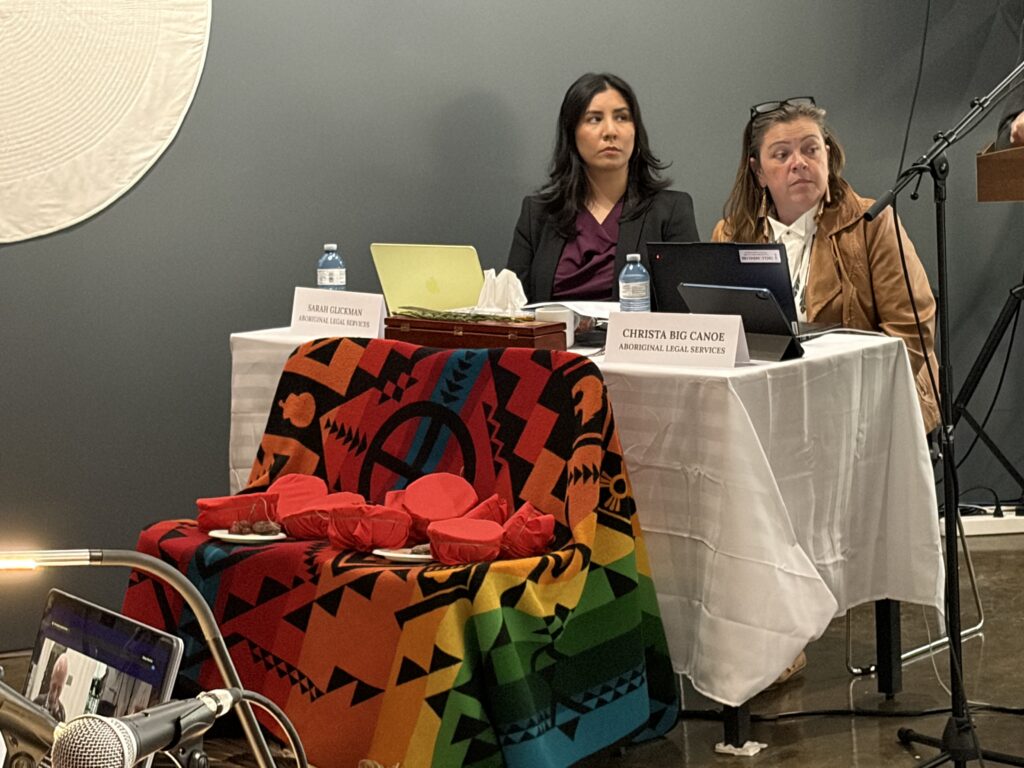
Christa Big Canoe and Sarah Glickman of Aboriginal Legal Services in Toronto at the Permanent Peoples’ Tribunal in Montreal, May 2026.
These examples were not presented to sensationalize online abuse. They demonstrated that Indian Residential School denialism is not simply a disagreement about history. It is a contemporary expression of colonialism and cultural supremacy that undermines Survivors lived experiences, contributes to racism, and creates barriers to truth and accountability.
Canoe noted that when governments fail to fully acknowledge both historical and ongoing harms committed against Indigenous Peoples, it can create conditions where individuals believe they can also act without consequence. This allows racism, hostility, and denialism to continue.
Why Does Denialism Persist?
Indian Residential School denialism persists because the harms of colonialism have not been fully confronted or addressed. While Canada has acknowledged that the Indian Residential School System caused profound harm, many Survivors, families, and Indigenous communities continue to call for meaningful accountability for the violations committed against Indigenous children and the ongoing impacts of colonial systems.
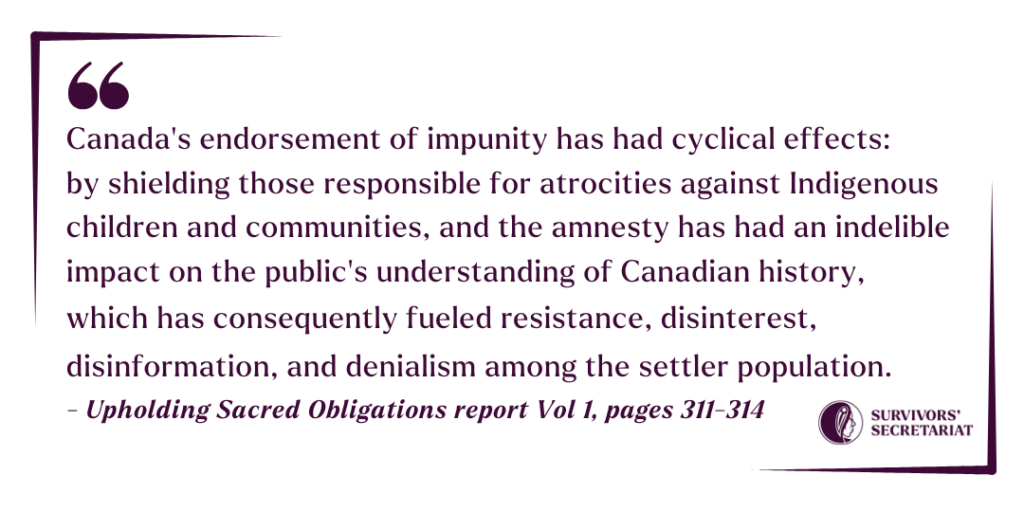
In Kim Murrarys’ report Upholding Sacred Obligations, the former Special Interlocutor identified settler amnesty and impunity as significant barriers to accountability. She explained that when governments and institutions avoid fully confronting responsibility for historical and ongoing harms, it affects how the public understands Canada’s history and creates conditions where denial and misinformation can continue.
Murray wrote:
To read more about Settle Amnesty and Impunity, click here.
How Impunity and Settler Amnesty have perpetuated harm on Indigenous Peoples
Indian Residential Schools and colonial legislation such as the Indian Act imposed government control over many aspects of First Nations way of life. Indian Residential Schools were one part of a broader colonial system designed to assimilate Indigenous Peoples, undermine Indigenous sovereignty, and assert control over Indigenous lands. While the schools have closed, many of the structures and policies that shaped them continue to affect Indigenous communities today.
The Permanent Peoples’ Tribunal not only heard evidence related to the Indian Residential Schools, but also reviewed other colonial systems including:
- • Child welfare systems;
- • Forced and coerced sterilization;
- • Suppression of Indigenous languages and cultures;
- • Displacement from lands and territories;
- • Discriminatory healthcare practices;
- • Policing and surveillance;
- • Overincarceration
- • MMIW2GS+
- • Land dispossession; and
- • The Indian Act
The Permanent Peoples’ Tribunal’s final judgement described the Indian Act’s band-membership system as “an institutionalized system of racial discrimination, and therefore a crime of apartheid.” — Page 47, Section 3.12
During the Tribunal, Dr. Fannie Lafontaine, testified about the imbalance of power between Indigenous Peoples and state institutions.
The roots of this imbalance can be traced through Canada’s own policies and language. An 1876 Department of the Interior Annual report described Indigenous people as being treated as “wards or children of the State”, reflecting an imposed system of guardianship and control that placed authority over First Nations’ lives, lands and governance in Canada’s hands.
Today, some First Nations continue to call for an end to the Indian Act’s second-generation cut-off. Bill S-2 includes proposed changes allowing entitlement to Indian status to pass through one eligible parent.
The current two generation cut-off illustrates how Canadian laws continue to control entitlement to Indian status across generations, rather than respecting First Nations’ authority to determine belonging through their own laws and kinship systems.
This is why Indian Residential School denialism is so harmful: it continues to not only minimizes past harms but also obscure the discrimination and inequalities that are still embedded in colonial systems that exist today.
Standing with Survivors

Mohawk Institute Survivors gathered for the Second Annual Survivors’ Gathering.
Everyone has a role in protecting truth. Silence allows denialism to grow, while action helps ensure Survivors’ lived experiences are respected and remembered.
Survivors, their families, and those working to uncover the truth should not have to confront denialism alone. Governments must address the harassment they face and take meaningful action to protect their safety and support Survivor-led work.
The Chiefs of Ontario and the Anishinabek Nation have expressed support for the Permanent Peoples’ Tribunal’s judgment and called for stronger action against Indian Residential School denialism. Ontario Regional Chief Abram Benedict stated, “The question is no longer whether denialism causes harm, but when Canada will act.”
The Anishinabek Nation also called on Canada to acknowledge the Tribunal’s findings and confront denialism, misinformation and anti-First Nation hatred. As Anishinabek Nation Grand Council Chief Linda Debassige affirmed, “Truth cannot coexist with denial; it’s time for Canada to act.”
Protecting the truths and lived experiences of Survivors is also a responsibility to future generations. The choices we make today will shape what they learn, remember, and carry forward. Standing with Survivors means turning our commitment to reconciliation into action grounded in truth, respect, and accountability for both historical harms and the harms that Indigenous peoples continue to face today.
To read the Chiefs of Ontario statement, click here.
To read the Anishinabek Nations statement, please visit there Facebook page here.
Blog written by Crystal L. Castellan, edited by Tabitha Curley